
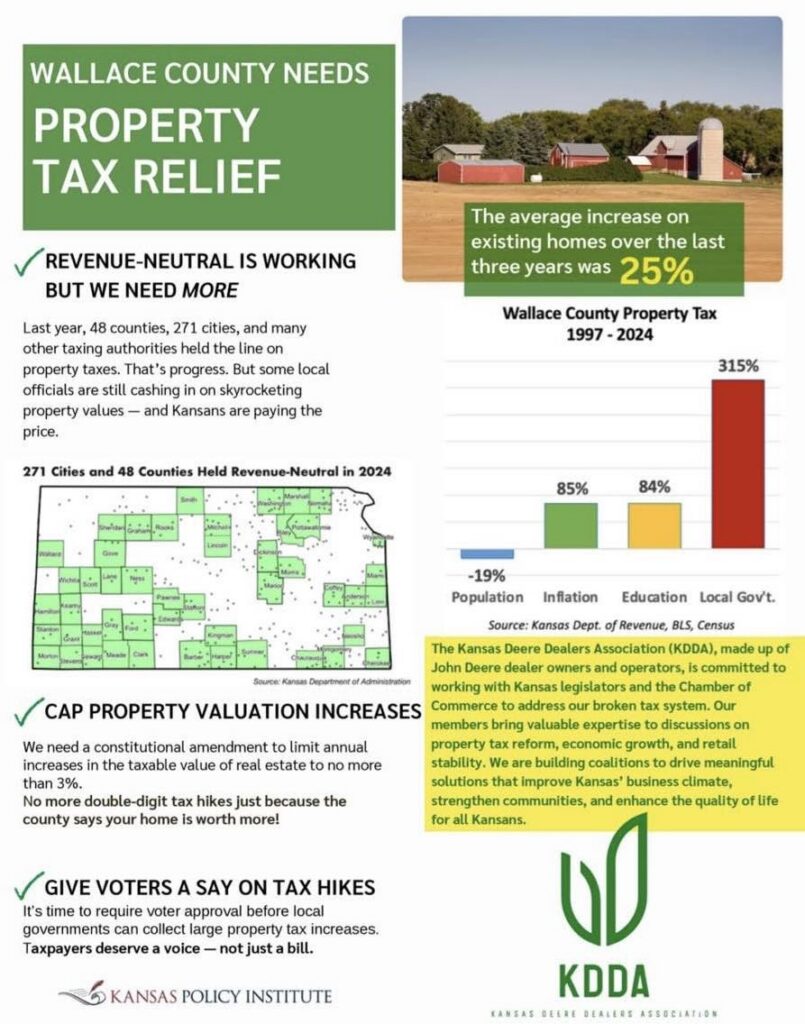
I’ve been made aware of a graphic going around Facebook and would love the opportunity to address its content.
Forewarning – it’s a lengthy read, but I want folks to understand the numbers. I’m always open to questions, concerns, further explanation, or new ideas. Please share privately or publicly, whatever you prefer!
This is an interesting graphic, I’ll try to tackle each “section” at a time for efficiency.
First of all, I have sat down with a leading member of the Kansas Deere Dealers Association. We’ve had very good conversations, but we simply disagree on the implementation of valuation caps. I’ll attempt to explain why in more detail below.
REVENUE NEUTRAL IS WORKING
Starting at the top left, no one can explain to me how revenue neutral is working. Just listing the cities and counties that were revenue neutral for one year doesn’t exactly prove much. Case in point: Wallace County is green, indicating it’s working in Wallace County? How? There is no accountability and no way for taxpayers to stop tax increases? There is not one elected official in the state that has lost their office because of voting for budgets that exceed revenue neutral. If anyone knows of one, please let me know.
Since the adoption of the revenue neutral law in 2020, Wallace County revenue from property taxes has increased 19.94% over 5 years . That’s right around 4% per year. Wallace County has stayed revenue neutral two years and exceeded three years. We had two years of 0% increase, but then increases other years of 2.34%, 9.91%, & 6.70%. So whether it was a steady increase of 4% each year or stair-stepped with years of large increases and years of no increase, we’ve ended up in the exact same spot.
To anyone reading this, I ask the honest question: do you feel like revenue neutral is working in Wallace County? If you do, that’s perfectly okay, and I would appreciate hearing your reasoning to that point, if you choose to share.
Another question – if you are a property tax payer, would you rather have small and somewhat predictable increases or years of zero followed by years of larger increases? I ask that knowing that everyone, including me, would prefer taxes to DECREASE.
As for the rest of those cities and counties that are green… they may have “held the line” last year, but what about other years?
Unfortunately, there are counties much worse off than us in Wallace County.
Wyandotte County is an urban KCK metro area county in the northeast part of the state. They were praised last year (and on this map!) as being revenue neutral and used as an example of how revenue neutral is working. However, in reality, their property taxes have increased 47% since revenue neutral law was passed – an average annual increase of 9.4%!!! They were revenue neutral last year, but the year before that it was about a 12.5% increase and this year it’s almost a 17% tax hike.
Because of this, I do not believe revenue neutral is “working”.
There is no real taxpayer control over excessive budget increases, and if you doubt that do an internet search for Seward County Tax Hike and read the most recent horror story about local officials that are oblivious to the tax burden they are placing on property owners.
PROPERTY VALUATION CAP
Moving on down to the valuation cap. Local governments don’t set the mill levy (property tax rate) and just live with whatever revenue that provides (like sales and income tax rates). Instead, they adopt their budgets and then calculate whatever mill levy they need to achieve their desired revenue. Therefore, a limit in your valuation is just going to result in a higher mill levy to provide the same amount of revenue. Advocates for this valuation cap claim that local governments will not raise their mill levy, they will cut their budgets. Again, google “Seward County Tax Hike” to read about how that will play out in reality.
By the way, who do you know that sits down and builds their household budget for the upcoming year, then goes in and tells their employer what to pay them? It doesn’t work that way for anyone else except government! The biggest problem with ALL taxes is that it’s way to easy to spend other peoples’ money, and it’s a problem at every level of government!
In Wallace County, if you live in the city limits of Sharon Springs, your total tax levy last year was 246.462. If you think that’s high enough and “surely the county/city/school elected officials would NEVER go any higher”, take a trip down to Greeley County – their mill levy in Tribune last year was 311.037! It’s a pipe dream to think the mill levy won’t increase, which is why a valuation cap will NOT work. If someone can show me the math on how a 3% cap will provide property tax relief without assuming mill levies won’t go up, I would love to see it!
GIVE VOTERS A SAY ON TAX HIKES.
That’s interesting, I tried to do this last year in my property tax relief bill – HB2396. It passed the House with huge bipartisan support 115-6. The Senate wouldn’t take a vote on it. Kansas Policy Institute opposed my idea last year and said the revenue neutral hearing was better. I still think it’s a great idea – if your local government wants to jack up your taxes, you should have the ability to put a stop to it. I WILL be running the House plan again next session. It is the best way to prevent excessive tax increases year over year. The Wyandotte and Seward County folks – and anyone else experiencing huge tax hikes – should LOVE it. (Too bad it didn’t get a vote in the Senate and pass last year, had it been in place, the Seward County problem wouldn’t be an issue.)
THE POPULATION / INFLATION / LOCAL GOVT CHART
I also find this interesting. Last year I proposed, in that same bill HB2396 that passed 115-6 in the House, a limit on local govt budgets of inflation plus new construction. (The reason I added new construction was for growing areas that have increased infrastructure requirements – new streets, sewer, electricity, etc. for new subdivisions cost money. Wallace County doesn’t have that kind of urban sprawl, but some communities do.) If I’m reading this chart correctly, over the last 27 years inflation has risen 85%. If my bill had been in place over the past 27 years to limit budget increases – guess what 85%/27 yrs equals?
3.15% / year!!! 
If you want a tax policy that would truly limit your property tax increases to about 3%, a revenue limit bill is the most effective! Unlike the valuation cap that doesn’t prevent mill levy increases, my revenue limit bill WOULD have held the line on actual tax dollar increases. The local govt bar on the chart would have looked closer to 85% rather than 315%!
The way my bill worked was it allowed a local government to adopt whatever budget they wanted, similar to what the revenue neutral law allows right now. BUT, if the increase exceeded inflation & growth, there was a protest petition where a small group of people could put a stop to anything over the limit.
Some people opposed my bill because they felt a protest petition is too hard, so this year I’m going to do what they preferred and move it to an election… even though it will take a lot more people to oppose it in order for the tax hike to be rejected. I still prefer a protest petition, but I’m trying to listen to my opposition and make this compromise.


