
Monday, July 20, 2026
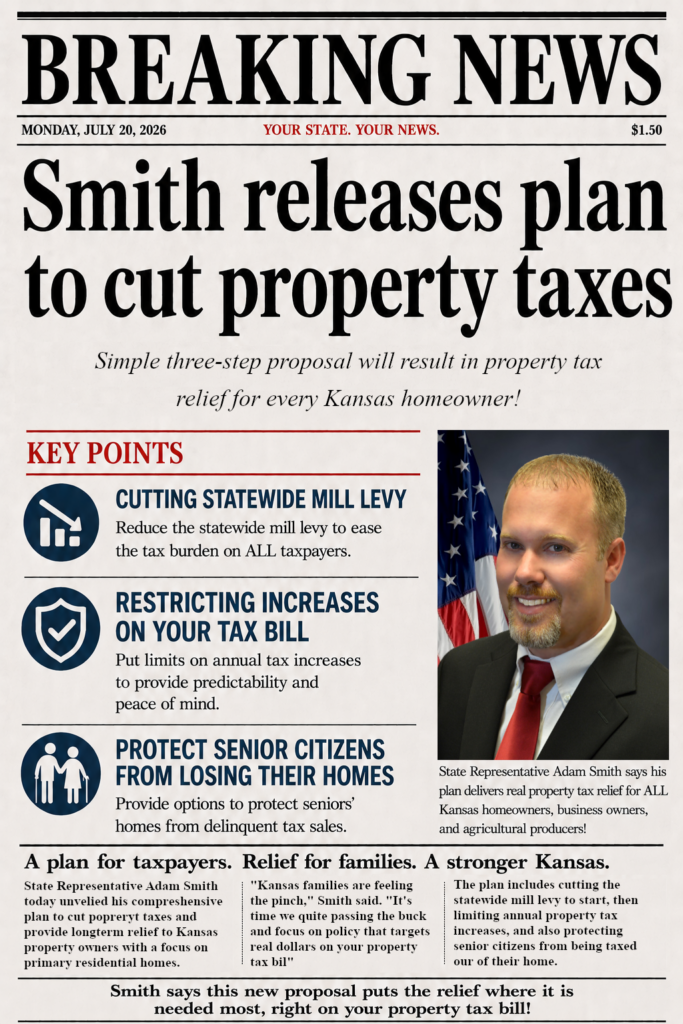
WESKAN – State Representative Adam Smith, chair of the House Taxation Committee, unveiled his comprehensive plan to provide property tax relief for all Kansas taxpayers, with an emphasis on primary residential property.
The three-part plan includes reducing the statewide mill levy, restricting future tax increases, and safeguarding senior citizens’ homes.
REDUCING THE STATEWIDE MILL LEVY
Kansas lawmakers set a statewide mill levy in statute to help provide funding for K-12 education. It has been set at 20 mills since 1998, renewed every two years by the legislature. In 1998, the total statewide assessed valuation was $18.85 billion dollars and that has grown to $53.65 billion in 2025. As valuations climbed, the property tax collections also climbed since there was no reduction in the mill levy.
“This has been a tax increase for anyone with an increase in valuation.” Smith said. “The property tax formula was designed with the intention of allowing a reduction of the mill levy when valuations skyrocket to prevent a subsequent skyrocket in property taxes. The legislature has not done this, and it’s time for that to STOP!”
Smith is proposing cutting the statewide mill levy in half to immediately reduce taxes for every property taxpayer in the state, then mandating that the mill levy be reduced further in the future if valuations continue excessive increases.
“This reduction will help everyone from homeowners to business owners, farmers and ranchers… literally anyone that pays property taxes!” he said.
RESTRICTING FUTURE INCREASES
The legislature has been mired in a policy proposal to cap property valuation over the past several years. Proponents say it is real property tax relief, but opponents say restricting the tax base will only result in an increase in the mill levy.
“Rather than chasing our tail with valuation caps that only manipulate one variable of the equation, why not cap the only number that really matters? …the dollar amount owed on your property tax bill!” Smith said.
He explained that a limit on your tax bill would negate any increases of your valuation. If the tax limit was 3% and your valuation went up 20%, it wouldn’t matter because your taxes would only increase by 3%.
But who pays the difference?
“If the state legislature wants to get serious about property tax relief, we need to be willing to pay for it.” Smith said. “You can’t cut taxes for free.”
He is proposing either a refund directly to the taxpayer from the state in the amount of the difference or a reduction in the taxpayer’s bill and the difference is paid directly to the county for proper distribution. The limit would only apply to “homestead” residential property – privately owned primary homes. Second homes, vacation rentals, and residential property owned by corporations would not qualify.
“The beauty of a refund program is that it doesn’t reduce local tax base and result in mill levy increases.” Smith said. “It won’t cause any shift of the tax burden onto other taxpayers.”
KEEPING SENIORS IN THEIR HOMES
“No one should ever be forced out of their home because of property taxes!” Smith said. “Our senior citizens should have the right to stay in the home where they raised their family and made generations of memories.”
Current tax law allows for a county to sell property at a foreclosure auction if there are delinquent taxes accumulated for at least three years. Most counties do not have enough delinquent parcels to follow that three year schedule, but a tax sale is usually always inevitable. However, no allowance is made for a home that is the primary residence of a senior citizen.
“Many of our seniors are on fixed incomes while the cost of living continues to increase, and property taxes are usually a substantial piece of that.” said Smith. “Add to that an unexpected expense like a health complication, and some seniors simply don’t have the money to pay their property taxes at the end of the year.”
“These folks just want to be able to stay in the place they’ve called home and live their golden years with peace and dignity.” he said.
Smith plans on creating an exception in the law for qualified senior citizens. He added an amendment to a bill last year that would have prohibited these tax sales for senior citizens’ homes, but there was concern of possible abuse if someone wanted to just stop paying their property taxes.
“I want it to be a simple and easy program, but I understand the concern about fraud so I’m willing to put guardrails in place to make sure this is available only to the people who need it most.” Smith said.